



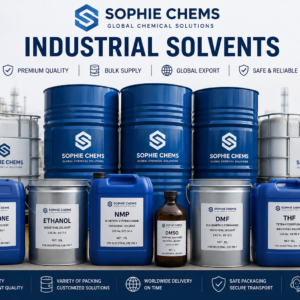
DMF Solvent: Properties, Uses, Structure & Industrial Applications
N,N-Dimethylformamide (DMF) is a highly polar organic solvent widely used in chemical synthesis, pharmaceutical manufacturing, and polymer processing. It is one of the most important polar aprotic solvents in modern industrial chemistry.
Chemical Structure & Identity of DMF solvent
DMF has the molecular formula C₃H₇NO and belongs to the amide class of organic compounds.
Key features:
Polar aprotic solvent
Amide functional group
High solvating ability
Physical and Chemical Properties
DMF is characterized by:
High boiling point
Strong polarity
Excellent miscibility with water and organic solvents
Stable reaction medium for organic synthesis
These properties make it widely used in controlled chemical processes.
🧪 N,N-Dimethylformamide (DMF)
📌 Molecular Formula:
C₃H₇NO
🧬 Meaning of the formula
C₃ → 3 carbon atoms
H₇ → 7 hydrogen atoms
N → 1 nitrogen atom
O → 1 oxygen atom
🧪 Chemical identity
This formula corresponds to:
N,N-Dimethylformamide (DMF)
A polar aprotic solvent widely used in:
organic synthesis
pharmaceutical manufacturing
polymer chemistry
🧠 Structural note
DMF is an amide compound, structurally related to formamide, with two methyl groups attached to nitrogen.
Industrial Applications of DMF
🧪 Organic synthesis
DMF is commonly used as a reaction solvent in:
nucleophilic substitution reactions
coupling reactions
multi-step organic synthesis.
💊 Pharmaceutical manufacturing
DMF is used in:
API intermediate synthesis
reaction media for complex molecules
laboratory-scale drug development
DMF is widely studied as a polar aprotic solvent in organic synthesis, as documented in chemical databases such as PubChem and scientific literature indexed in PubMed.
👉
PubChem → https://pubchem.ncbi.nlm.nih.gov�
PubMed → https://pubmed.ncbi.nlm.nih.gov�
Related Solvents.
DMSO
🧵 Polymer and materials industry
DMF plays a role in:
polymer fiber production
resin processing
synthetic material formulation
Role as a Polar Aprotic Solvent
DMF is classified as a polar aprotic solvent, meaning:
it does not donate hydrogen bonds
it stabilizes ions in solution
it enhances reaction rates in organic chemistry
H2: Safety and Handling
DMF requires strict safety protocols:
avoid prolonged exposure
use protective equipment
ensure proper ventilation
follow occupational exposure limits
Chemical Classification
Type: Organic solvent
Class: Polar aprotic amide solvent
Category: Industrial chemical intermediate solvent
Related Industrial Solvents
Dimethyl sulfoxide (DMSO)
N-Methyl-2-pyrrolidone (NMP)
Acetonitrile
Tetrahydrofuran (THF)
Frequently Asked Questions (FAQs)
What is DMF solvent?
DMF (Dimethylformamide) is a colorless, polar aprotic organic solvent with the chemical formula C₃H₇NO. It is widely used in chemical synthesis, pharmaceuticals, coatings, adhesives, polymers, and laboratory research because it dissolves a wide range of organic and inorganic compounds.
What is the chemical formula of DMF?
The chemical formula of Dimethylformamide (DMF) is C₃H₇NO.
What are the main uses of DMF solvent?
DMF is commonly used in:
Pharmaceutical manufacturing
Chemical synthesis
Polymer and resin production
Adhesives and coatings
Synthetic leather manufacturing
Textile processing
Electronics manufacturing
Laboratory research
Why is DMF considered a polar aprotic solvent?
DMF has a high dielectric constant and dissolves many ionic and organic substances without donating hydrogen ions, making it an excellent polar aprotic solvent for many chemical reactions.
What industries use DMF?
DMF is used in industries including:
Pharmaceuticals
Fine chemicals
Petrochemicals
Electronics
Textiles
Paints and coatings
Plastics and polymers
Agrochemicals
Is DMF soluble in water?
Yes. DMF is completely miscible with water and also mixes well with many organic solvents such as acetone, ethanol, methanol, and chloroform.
What are the physical properties of DMF?
Typical properties include:
Appearance: Clear, colorless liquid
Molecular weight: 73.09 g/mol
Boiling point: Approximately 153°C
Melting point: Approximately −61°C
Density: About 0.94 g/cm³ (20°C)
Is DMF hazardous?
DMF should be handled with appropriate safety precautions. It can be absorbed through the skin and may pose health risks with repeated or prolonged exposure. Always use suitable personal protective equipment (PPE), adequate ventilation, and follow the Safety Data Sheet (SDS).
How should DMF be stored?
DMF should be stored in tightly sealed containers in a cool, dry, well-ventilated area, away from heat sources, strong oxidizing agents, and direct sunlight.
Can DMF be supplied in bulk?
Yes. Chemical suppliers typically offer DMF in laboratory bottles, drums, intermediate bulk containers (IBCs), and bulk tanker quantities for industrial applications.
What is the CAS number of Dimethylformamide?
The CAS number for Dimethylformamide (DMF) is 68-12-2.
What is the difference between DMF and DMSO?
Both are polar aprotic solvents, but they differ in chemical structure, boiling point, odor, toxicity profile, and suitability for specific industrial and laboratory applications. The best choice depends on the intended process and compatibility requirements.
Conclusions .
N,N-Dimethylformamide (DMF) is a highly important polar aprotic solvent widely used across organic synthesis, pharmaceutical manufacturing, and industrial chemical processes. Its strong solvating ability, high polarity, and chemical stability make it a core solvent in modern laboratory and large-scale industrial applications.
Although DMF is highly effective in chemical reactions and production systems, it requires careful handling due to its potential health and safety risks under prolonged exposure. As a result, it is regulated under standard industrial chemical safety frameworks and is used under controlled conditions in both research and manufacturing environments.
Overall, DMF remains a key industrial solvent in chemical science, valued for its versatility, performance, and broad application in advanced chemical synthesis.
Reviews
There are no reviews yet.